Lawn
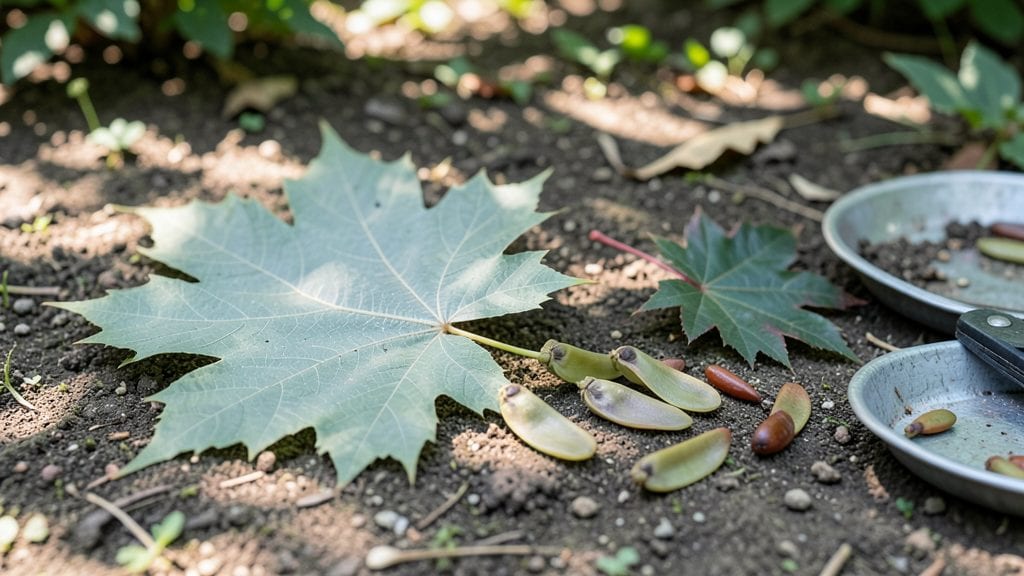
Mastering maple seed identification starts with their wings and leaf shapes: sugar maples feature 3-inch samaras and rounded leaves, while red maples show longer wings and sharper edges. 🌿 I’ve spent years collecting these seeds—some are easy to spot, others blend into fall leaf litter until you know what to look for.
Start by comparing wing length and leaf shape: sugar maples have smooth-edged wings and lobed leaves, while silver maples sport longer, narrower wings with rougher leaf margins. A magnifying glass helps reveal these details, especially when seeds mix with oak acorns or hickory nuts.
I keep a small notebook to sketch what I find—it sharpens my eye over time.
Once you master the basics, you’ll notice how each species behaves differently. Sugar maple samaras spiral to the ground, while red maple seeds often cling to branches longer.
This knowledge isn’t just for fun—it’s the first step to growing your own maples or understanding why certain trees thrive in your yard. The best part? You’ll start seeing these details everywhere after just a few outings.
For gardeners, this skill opens doors: propagate rare maples, identify invasive species early, or even track seasonal changes. The more you observe, the more the forest reveals itself. Grab a bag and start collecting—your local maples have stories to tell.
How Nature Shapes Seed Spread
Maple seeds—those iconic helicopter-like samaras—don’t just flutter randomly. Their design and dispersal are the result of a fascinating blend of evolutionary biology, physics, and environmental adaptation. Understanding why they look and behave the way they do helps you spot the differences between species.
Here’s why maple seeds take flight—and how their traits reveal their tree origins.
Maple seeds are masterpieces of passive dispersal, relying on wind to carry them far from the parent tree. Their distinctive winged shape isn’t just for show—it’s a highly efficient aerodynamic system that maximizes lift while minimizing drag. Here’s the science behind it:
- Wing Surface Area: The broad, paper-thin wings create lift by increasing air resistance on one side while allowing smooth airflow underneath. Think of it like a tiny airplane wing—longer wings (like those on sugar maples) generate more lift, enabling seeds to travel farther.
- Seed Weight Balance: The seed itself is small and dense, positioned at the center of gravity of the wing. This balance ensures stable rotation, preventing wobbly or erratic flight. Heavier seeds (like those from red maples) may spin faster, while lighter ones glide more slowly.
- Twisting Motion: As the seed falls, it rotates like a helicopter blade, creating a gyroscopic effect that slows descent. This twist isn’t random—it’s a result of the wing’s asymmetrical design, which catches air currents at an angle. Pro tip: Observe the seed’s spin direction; some species (like silver maples) twist clockwise, while others go counterclockwise!
💡 Actionable Insight: If you notice seeds with shorter wings or thicker centers, they likely belong to maples that evolved in dense forests where wind is less reliable. Longer-winged seeds? Those trees probably grow in open areas where wind dispersal is key.
Maple seeds didn’t just evolve wings—they fine-tuned them over millennia to outcompete other plants for sunlight and space. Three key evolutionary drivers shape their differences:
🌿 Competition for Sunlight
In crowded forests, maple seedlings must reach light quickly. Trees with seeds that land farther from the parent (thanks to longer wings) have a survival advantage. For example:
- Sugar maples (with their long, narrow wings) often grow in mixed hardwood forests where sunlight is scarce. Their seeds can travel up to 200 feet, reducing competition near the mother tree.
- Red maples, found in more open or disturbed areas, have shorter, wider wings—a trade-off for faster germination rather than extreme distance.
🌎 Climate and Wind Patterns
Maples in windy regions (like northern forests) develop seeds optimized for long-distance travel, while those in sheltered or tropical areas may prioritize stability over distance. For instance:
- Silver maples, native to riverbanks and swamps, have large, divided wings that catch even gentle breezes near water.
- Boxelder maples (common in urban areas) produce seeds with uneven wings, which may indicate adaptation to turbulent city winds or faster germination in disturbed soils.
🐦 Avoiding Seed Predators
Birds, squirrels, and insects love maple seeds—but not all seeds are equally vulnerable. Some maples have evolved traits to delay germination or deter herbivores:
- Thicker seed coats (common in black maples) can resist cracking from beak pressure.
- Faster germination (like in Norway maples) ensures seeds sprout before predators notice them.
- Toxic compounds in some species (e.g., poison ivy-adjacent boxelder maples) may deter animals from eating them.
🔥 Field Tip: If you find seeds with irregular wings or damaged edges, they may have been partially eaten by insects or birds. This can hint at the tree’s local predator pressures!
You can’t talk about maple seeds without mentioning their leaves—because the two are genetically linked. Maple trees produce seeds that reflect their leaf structure, growth rate, and even water transport efficiency. Here’s how:
🍃 Vascular System Efficiency
The way a tree moves water and nutrients affects seed production. Trees with:
- Lobed leaves (like sugar maples) often have larger seed wings because they invest more energy in growth and dispersal.
- Smooth or serrated edges (like red maples) may produce smaller, denser seeds to conserve energy in drier climates.
🌱 Growth Speed and Seed Maturity
Fast-growing trees (like silver maples) mature seeds quickly but may sacrifice wing quality for volume over precision. Slower-growing species (like sugar maples) prioritize precision dispersal with longer wings.
🎯 Identification Hack: Pair seed wing shape with leaf characteristics:
- 🍁 U-shaped lobes (sugar maple) + long, tapered wings = classic "helicopter" seed.
- 🌿 Pointy, serrated leaves (red maple) + shorter, sturdier wings = quicker germination.
Quick Fixes for Maple Seed Confusion
Got tangled in maple seed mysteries? Whether you’re trying to identify a tree, avoid yard clutter, or just satisfy curiosity, these practical solutions will help you decode those whirling helicopter seeds—fast.
If you’re staring at a maple seed and wondering, "Is this a sugar maple or silver maple?", here’s how to tell them apart:
📏 Compare Wing Size & Shape - Sugar Maple (Acer saccharum): Wings are longer (3–4 inches) and narrower, with a gentler curve.
The seed itself is smaller and pointier. - Silver Maple (Acer saccharum): Wings are shorter (2–3 inches) but wider, with a sharper V-shape.
The seed looks bulkier at the base. - Red Maple (Acer rubrum): Wings are medium-length (2.5–3.5 inches) but thicker and sturdier, often with a more pronounced kink near the seed.
> 💡 Pro Tip: Hold the seed against a ruler or your palm—the size difference is easier to spot when scaled to something familiar.
🍂 Check the Leaf (If Available)
Since seeds fall before leaves sprout, save a few until spring to confirm:
- Sugar Maple: 5 lobes, deep U-shaped notches, serrated edges.
- Silver Maple: 5 lobes, but broader and less defined, with shallower notches.
- Red Maple: 3–5 lobes, pointier, with brighter red undersides (in fall).
If your yard is flooded with maple samaras (the fancy name for those helicopter seeds), try these low-effort fixes:
🌬️ Let Nature Handle It (Best for Most Cases)
- Rake in batches when seeds are dry and crispy (early fall or late winter).
- Use a leaf blower on a low setting to shoot seeds into piles—then dispose of them.
- Mulch them (if you have a compost bin or garden).
They break down quickly and add nutrients.
> ⚠️ Warning: Avoid burning them—green seeds can release irritating smoke.
🗑️ Dispose of Them Properly
- Trash bags: Collect seeds in a heavy-duty bag (they’re lightweight but add up fast).
- Compost: If your bin handles small wood chips, maple seeds are safe to compost.
- Donate to wildlife: Some birds (like goldfinches) eat the seeds—leave a few if you want to attract them!
🌳 Prevent Future Seed Storms
- Prune trees in late winter/early spring (before seeds form) to reduce seed production.
- Plant ground covers (like clover or creeping thyme) to compete with seed growth.
- Install a seed trap (a wire mesh barrier around the tree base) to catch falling seeds before they scatter.
For botanists, landscapers, or hardcore tree nerds, dig deeper:
📸 Use a Plant ID App
- PictureThis or Google Lens can scan the seed/leaf and match it to a database.
- Upload to iNaturalist—a community of plant experts can confirm your ID.
📚 Consult a Field Guide
- "Peterson Field Guide to Trees" (classic, but heavy).
- "The Audubon Society Field Guide to North American Trees" (lighter, great for beginners).
- USDA Plant Database (plants.usda.gov)—free and searchable by seed/leaf traits.
🌿 Visit a Local Arboretum or Nursery
- Ask an expert—many offer free ID services or have press-dried seed samples for comparison.
- Bring a photo if you can’t carry a seed (some decompose fast).
If maple seeds are annoying your lawn or garden, take proactive steps:
| Problem | Solution | Prevention Tip |
|---|---|---|
| Seeds clog gutters | Install gutter guards or rake them out weekly | Trim branches hanging over roofs |
| Seeds grow into weeds | Mulch heavily or solarize soil (black plastic + sun) | Plant dense ground cover to block light |
| Seeds attract pests | Remove seed piles (rats/squirrels love them) | Store birdseed in metal containers |
| Don’t want more trees | Prune seed-bearing branches in winter | Choose female trees (they produce fewer seeds) |
Before you give up on ID, ask yourself: ✅ Are the wings long and narrow? → Likely sugar maple. ✅ Are the wings short and wide? → Probably silver maple. ✅ Is the seed bulky at the base? → Could be red or box elder maple. ✅ Do you have a leaf? → Compare lobes and notch depth for 100% accuracy.
Now you’re armed with the knowledge to spot, ID, and manage** maple seeds like a pro! 🚀
Frequently asked questions
How do I tell the difference between sugar maple and red maple seeds?
Look at the wings and seed shape: sugar maple seeds have longer, narrower wings (3-4 inches) with a gentle curve, while red maple seeds feature shorter, sturdier wings (2.5-3.5 inches) and a thicker base. Sugar maple seeds also spin more gracefully in the wind.
Why do some maple seeds fly farther than others?
Wing length determines flight distance—longer wings (like sugar maple's) create more lift and can travel up to 200 feet, while shorter wings (red maple) prioritize quicker germination over distance. The seed's weight and wing balance also affect stability during flight.
Can I grow a tree from a maple seed I found?
Yes, but success depends on the species. Sugar maple seeds germinate best when stratified (cold-treated) for 60 days in moist sand, while red maple seeds often sprout faster. Plant them 1/4 inch deep in well-draining soil and keep moist. Patience is key—some take 2-3 years to sprout!
What should I do with all the maple seeds in my yard?
Rake them up when dry, compost them, or use a leaf blower to gather piles. Avoid burning green seeds—they release irritating smoke. For prevention, prune trees in late winter or install a wire mesh barrier around the base to catch falling seeds.
Are there any toxic maple seeds?
Most maple seeds are safe, but boxelder maple seeds contain small amounts of toxic compounds that can cause mild stomach upset if eaten in large quantities. Never consume seeds you can't positively identify.