Trees
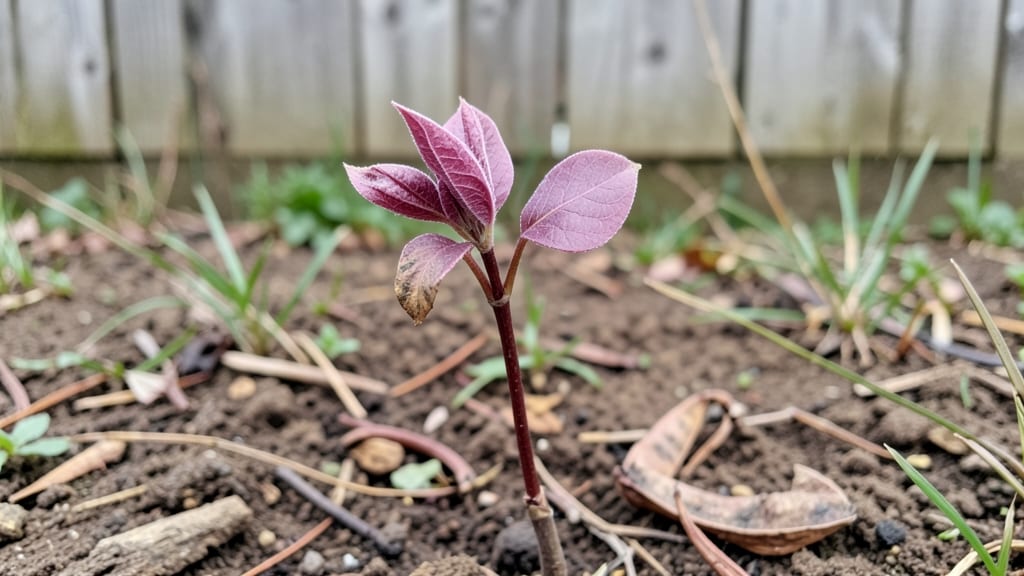
The identification of a redbud seedling begins with those unmistakable heart-shaped leaves—the first telltale sign among spring’s early bloomers. I’ve spent years sorting through nursery flats where young redbuds get mistaken for dogwoods or even cherry seedlings, and those heart-shaped leaves with smooth edges are the giveaway.
The bark on young stems is another dead ringer: silvery-gray and smooth as glass, not the rough texture of hickory or the scaly look of birch.
Here’s the thing—confusing redbud seedlings with lookalikes costs you time and space. A misidentified sapling might not thrive in your zone or could grow into a weak, disease-prone tree.
But once you spot those distinctive leaves and silvery bark, you’ll know you’ve got a true redbud on your hands, ready to burst with pink blooms in just a few years.
The real magic happens when you confirm it by growth habit: redbuds grow upright but lean toward spreading branches as they mature. That’s when you’ll see the true potential—a tree that’s drought-tolerant, low-maintenance, and perfect for small yards or urban landscapes.
No more guessing games when you know these key traits.
Now, if you’re still unsure, here’s a pro tip: snap a photo of the leaves and bark and compare it to a mature redbud’s features. That’s how I double-check my own seedlings before planting. The more you look, the easier it gets—and soon, you’ll spot them in the wild too.
What Triggers Confusion in Identification
Identifying young redbud seedlings can be surprisingly tricky, even for experienced gardeners. The mix-up often stems from a few key factors—some rooted in biology, others in environmental conditions.
Understanding these causes will help you spot the subtle (and not-so-subtle) clues that set redbuds apart from lookalikes like honeylocust, black locust, or even dogwood saplings.
One of the biggest redbud identification pitfalls is that its juvenile leaves can closely mimic those of other trees. Here’s why:
- Slow leaf maturation: Redbud seedlings (Cercis canadensis) start with simple, rounded leaves that resemble those of black locust or honey locust. Unlike mature redbuds, which develop heart-shaped leaves with a slightly notched tip, young leaves may appear entire (smooth-edged) or even slightly lobed—confusing them with other Fabaceae family members.
- Variable leaf shape: Environmental stress (like drought or poor soil) can cause redbud leaves to develop irregular shapes, making them harder to distinguish. For example, a seedling in shade might produce smaller, asymmetrical leaves, while one in full sun could grow broader, more typical heart-shaped foliage.
- Color shifts: Young redbud leaves emerge a vibrant reddish-purple, but this fades to green as they mature. If you’re identifying seedlings in early spring, the color alone might not be enough—especially if the tree is hybridized or stressed.
Pro tip: 🔍 Look at the leaf arrangement—redbuds have alternate leaves (one leaf per node, spiraling up the stem), while black locusts often have compound leaves (multiple leaflets per stem).
The bark of a young redbud is another common stumbling block. Unlike mature redbuds, which develop smooth, reddish-brown bark, seedlings often have:
- Thin, striated bark: Young stems may appear greenish-gray with fine, vertical ridges—easily mistaken for dogwood or serviceberry saplings. Dogwood bark, however, tends to be smoother and more silvery when young.
- Lenticels (pores) confusion: Redbud seedlings sometimes develop small, raised lenticels (breathing pores) along the stem, which can resemble the warty texture of black locust bark. Black locust, though, usually has deep grooves and a shaggier appearance.
- Bark color fading: In shaded or moist conditions, redbud bark may darken to a near-black hue, making it harder to distinguish from ironwood or hackberry seedlings.
Actionable clue: 🌡️ Run your fingers along the stem—redbud bark is slightly rough to the touch (like fine sandpaper), while dogwood bark feels smoother and waxier.
Redbud seedlings don’t always grow "by the book," and their growth patterns can lead to misidentification:
- Multi-trunk confusion: Unlike single-stemmed trees like dogwood, redbud seedlings often sprout multiple slender stems from the base. This can resemble serviceberry or wild plum seedlings, which also have clustered shoots.
- Slow initial growth: Redbuds are late bloomers—they may take 2–3 years to produce their iconic pink spring flowers. If you’re only seeing foliage, you might dismiss it as a weed or misidentify it as a wintergreen or partridgeberry sapling.
- Root suckers vs. true seedlings: Redbuds can produce root suckers (clones of the parent tree) that lack the genetic diversity of true seedlings. These may have weaker, less vigorous growth, leading observers to overlook them as potential redbuds.
Field test: ✨ Check for bud scales—redbud buds are oval and slightly sticky when closed, while dogwood buds are pointed and non-sticky.
Not all redbud seedlings look the same—and that’s often due to their environment or genetics:
- Hybrid vigor: Redbuds can crossbreed with other Cercis species (like Cercis chinensis, the Chinese redbud), resulting in seedlings with larger leaves, different flower colors, or altered growth habits. These hybrids may lack the classic heart-shaped leaf.
- Soil and moisture effects: Clay-heavy soils can stunt redbud growth, leading to smaller, darker leaves that resemble ironwood or hazelnut seedlings. Conversely, overly wet conditions may cause yellowing (chlorosis), masking the true leaf color.
- Pest and disease damage: Aphids, spider mites, or fungal infections (like anthracnose) can distort redbud leaves, making them crinkled, curled, or spotted—traits that might lead you to rule out redbud entirely.
Solution: 💡 Compare multiple seedlings—if you find a cluster with consistent traits (even if imperfect), they’re more likely to be true redbuds. Isolated oddballs may be hybrids or affected by stress.
Quick Fixes for Seedling Confusion
Got a young tree that looks almost like a redbud but isn’t quite right? Misidentifying seedlings can lead to pruning mistakes, incorrect care, or even removing the wrong plant! Here’s how to correctly ID redbud seedlings and avoid common pitfalls—plus tips to keep your young trees thriving.
Redbud seedlings have heart-shaped leaves with smooth edges, but other trees (like hickory or ash) can trick you. Here’s how to tell them apart:
- 🍃 Redbud Leaves:
- Shape: Classic heart (cordate) with a pointed tip.
- Size: 2–4 inches long, slightly fuzzy when young.
- Color: Bright green in spring, turning yellow before dropping in fall.
- 🚫 Common Look-Alikes:
- Hickory: Leaves are compound (multiple leaflets) and toothed.
- Ash Tree: Leaves are opposite (grow in pairs) and have 7–9 leaflets.
- Dogwood: Leaves are elliptical (not heart-shaped) with wavy edges.
✨ Pro Tip: Snap off a leaf and look at the stem attachment. Redbud leaves grow alternately (one per node) and have a smooth, slightly hairy stem.
Young redbud bark is smooth and grayish-brown, but as it matures, it develops ridges and furrows.
If your seedling has: - 🔴 Scaly or peeling bark → Likely a hackberry or shagbark hickory. - 🟢 Thin, green stems → Could be a boxelder (maple family). - 🟡 Fuzzy twigs → Might be a willow or cottonwood.
💡 Quick Test: Scratch the bark—if it’s soft and fibrous, it’s probably not a redbud.
Redbuds are one of the first trees to bloom in spring, with pinkish-purple flowers before leaves emerge.
If you spot: - 🌸 Clusters of small, bell-shaped flowers → Redbud confirmed! - 🌿 Long, flat seed pods → Could be a locust or mesquite. - 🍒 Berry-like fruits → Likely a hawthorn or serviceberry.
⏰ Timing Matters: If flowers appear after leaves, it’s not a redbud (they bloom before foliage).
Still unsure? Tech to the rescue!
- 📱 LeafSnap App – Upload a photo for instant ID.
- 📖 "Tree Finder" by Wm. Cullina – A classic field guide for Eastern U.S. trees.
- 🌿 Local Arboretum Hotline – Many offer free ID help.
🔥 Prevention Tip: Take photos from multiple angles (leaves, bark, flowers) before planting or pruning.
If all else fails, dig up the seedling (gently!) and check the root structure:
- Redbud roots are fibrous and shallow.
- Invasive species (like tree of heaven) have deep, aggressive roots.
⚠️ Warning: Only do this if you’re 100% unsure—digging can stress young plants.
Once you’ve ID’d your seedling correctly, give it the right care:
- 💧 Watering: Keep soil moist but not soggy (redbuds hate "wet feet").
- ☀️ Sunlight: Full sun to partial shade (6+ hours of light).
- 🪓 Pruning: Remove dead or crossing branches in late winter/early spring.
- 🌱 Mulching: Use 2–3 inches of mulch (keep it away from the trunk).
🎯 Golden Rule: If in doubt, wait until spring when flowers (or lack thereof) will confirm the ID.
Final Thought: A little patience and observation go a long way! Now you can spot a redbud seedling like a pro—and keep your garden (or forest) thriving with the right trees. 🌳✨
Frequently asked questions
How can I tell if my seedling is a redbud versus a dogwood?
Look at the leaves first—redbuds have heart-shaped leaves with smooth edges, while dogwoods have elliptical leaves with wavy edges. Also check the bark: redbud bark is slightly rough and silvery-gray, while dogwood bark is smooth and waxy when young. Finally, redbuds bloom before leaves appear in spring.
What should I do if my redbud seedling has irregular leaves?
Irregular leaves could mean stress from drought, poor soil, or pests. Water consistently and amend soil with compost. If leaves are curled or spotted, check for aphids or fungal issues—treat with neem oil if needed. Most redbuds develop classic heart-shaped leaves by their second year.
Can I identify a redbud seedling without flowers?
Yes! Focus on three key traits: heart-shaped leaves, silvery-gray bark, and alternate leaf arrangement (one leaf per node). Compare these to common lookalikes like hickory (compound leaves) or ash (opposite leaves). If unsure, use a tree ID app or consult a local arboretum.
Why do some redbud seedlings have multiple stems?
Redbuds naturally produce multiple slender stems from the base, especially when young. This isn't a problem—it's how they grow! Prune to one strong stem if desired, but avoid removing all stems at once. The tree will develop a single trunk as it matures.
How long does it take for a redbud seedling to flower?
Most redbud seedlings take 3-5 years to produce their iconic pink flowers, depending on growing conditions. If your seedling is older than 5 years and still hasn't bloomed, it might be a hybrid or affected by stress. Ensure it gets full sun and well-draining soil.