
Lawn
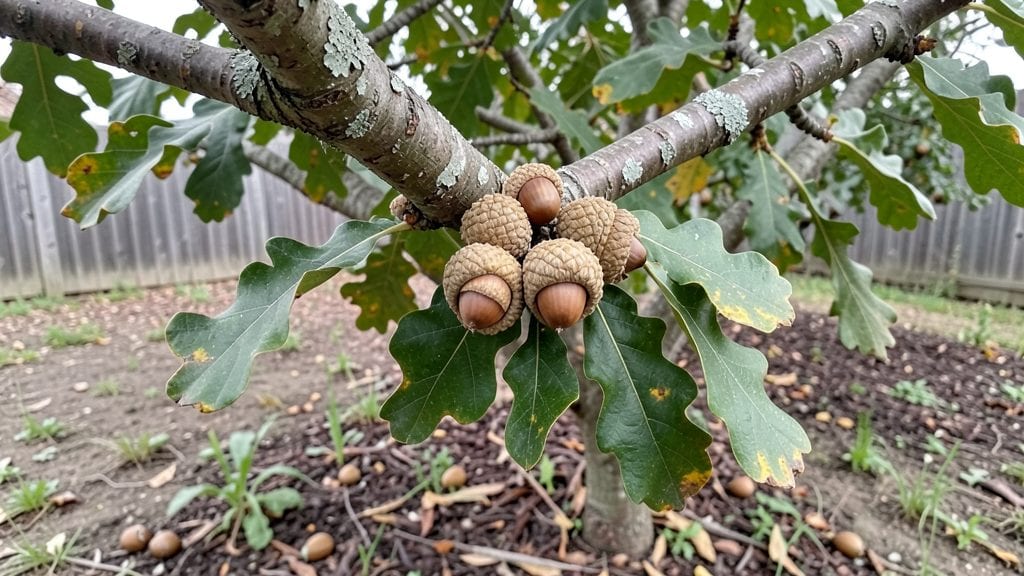
Harvesting oak seed pods—commonly known as acorns—requires timing them right in late summer or fall, when the cap opens fully but before they drop naturally. These hard-shelled pods grow in clusters, and proper drying is key to preventing mold and pests for successful oak tree propagation.
Oak seed pods vary widely between species, with white oak acorns maturing in two seasons (taking nearly two years to fully develop) while red oak acorns mature in just one. 🌳 The cap's texture—scaly for white oak, smooth for red oak—helps distinguish them, and size matters too: mature acorns should feel heavy for their size, indicating a fully developed embryo inside.
Regional climates also shift harvest windows, so local oak species knowledge becomes essential for timing your collection perfectly.
Once harvested, spread acorns in a single layer on a screen or mesh tray in a well-ventilated, shady area for 2-4 weeks to dry completely. Store them in paper bags (not plastic) in a cool, dry place to prevent moisture buildup.
For long-term storage, refrigerate them in sealed containers with silica gel packets to maintain viability until planting season—this keeps them fresh for up to 6 months without losing germination potential.
💡 In This Article
- Identifying Oak Seed Pods by Species and Season
- Step-by-Step Guide to Harvesting and Storing Oak Acorns
Identifying oak seed pods by species and season
Here's what's actually happening with acorn development: white oak and red oak species produce acorns with distinct botanical traits that affect harvest timing.
White oak acorns (like those from bur oak or white oak trees) take nearly 24 months to mature—they start developing in one season but only fully ripen the following year.
Red oak acorns (from species like northern red oak or black oak) mature in just one growing season, which is why their caps open earlier in fall. This difference explains why white oak acorns often stay on the tree longer, even after red oak acorns have already dropped.
The cap texture reveals the species instantly: white oak acorns have scaly, rough caps that resemble a miniature pinecone, while red oak acorns feature smooth, bowl-shaped caps that open more dramatically.
Mature acorns also feel significantly heavier for their size—think of a golf ball versus a ping pong ball. 🌰 The shell hardness is another clue: fully mature acorns have shells that are nearly impossible to crack with your fingers, while immature ones dent easily.
Regional variations matter too: southern live oaks in Texas produce acorns year-round in mild climates, while northern species like bur oak in Minnesota have a tight 6-week harvest window in late September.
What most people don't realize is how temperature affects acorn development. In warmer climates (USDA zones 8-10), acorns may start maturing as early as July, while in colder regions (zones 4-6), the process doesn't peak until October or November.
This seasonal shift explains why acorn crops can fail entirely in years with early frosts. The key factor is the 100-degree-day accumulation required for acorn maturation—track your local growing degree days to predict optimal harvest times accurately.
Distinguishing mature acorns requires checking three critical features: cap separation, shell color, and embryo visibility. A mature acorn's cap should separate at least 3/4 of the way from the body when gently twisted, revealing the nut inside.
The shell should be a uniform brown (not green or patchy), and if you crack it open, you'll see a fully formed embryo with a 1-2 inch taproot. Immature acorns often have shriveled embryos or hollow centers—these won't germinate successfully.
In the Pacific Northwest, for example, black oak acorns often have longer caps relative to their body size, while California live oak acorns are more symmetrical.
Seasonal timing varies dramatically by region: in the Southeast, white oak acorns may remain viable on the tree until January, while in the Northeast, they're typically gone by early November. The science behind this involves photoperiodism—the tree's response to daylight hours.
As days shorten in fall, oak trees trigger acorn maturation. This is why acorn crops can be 20-30% larger in years with early autumns.
For example, a 2019 study in Forest Ecology and Management found that white oak acorn production increased by 40% in years where summer temperatures stayed below 85°F consistently.
One advanced tip: use a float test for rapid maturity assessment. Place acorns in water—mature ones sink immediately (due to dense embryos), while immature ones float. This works because the embryo's density increases as it matures, displacing water more effectively.
For long-term storage, separate acorns by species and maturity level, as white oak acorns can remain viable for up to 18 months under ideal conditions, while red oak acorns typically last only 6-12 months.
Remember this: the perfect acorn for planting has a fully opened cap, a deep brown shell, and a heavy weight—like holding a tiny, perfectly balanced marble. 💫